
On Sept. 29, 2021, a firestorm hit the birding community. A press release from the U.S. Fish and Wildlife Service announced that the ivory-billed woodpecker would soon be considered extinct.
“…America’s largest woodpecker,” the press release stated, had its “last commonly agreed upon sighting… in April 1944 on the Singer Tract in the Tensas River region of northeast Louisiana… it has not been relocated.”
What ensued was some considerable uproar.
John Fitzpatrick, Cornell University ornithologist and the lead author of a 2005 paper claiming that the woodpecker had been rediscovered in eastern Arkansas, told the Associated Press that “Little is gained and much is lost” if the bird was declared extinct.
Tim Gallagher – another ivory-billed woodpecker searcher – called this declaration premature in an interview with Matt Mendenhall for the BirdWatching newsletter. Gallagher believes enough evidence has been gathered over the years to justify keeping the bird on the endangered list.
Indeed, this recent ivory-billed woodpecker extinction scare is not the first. Ornithologist and a longtime searcher of the elusive bird Geoff Hill also provided commentary for the above-mentioned newsletter, reflecting that this is the third time in the last century that the bird was declared extinct, and he is convinced that the cycle will continue.
All of this dissent led to another press release by the Fish and Wildlife Service on July 6, 2022, in which they announced that they would be extending the final decision on the status of the woodpecker by six months.
Well, one may certainly observe it’s been more than six months since July 2022. If you view the page for the ivory-billed woodpecker on the Fish and Wildlife Service website, you’ll notice the usage of the present tense “is.”
What gives? Is this bird extinct or not? Why do we care?
Before we begin to answer this, it is pertinent to know what we are looking for.
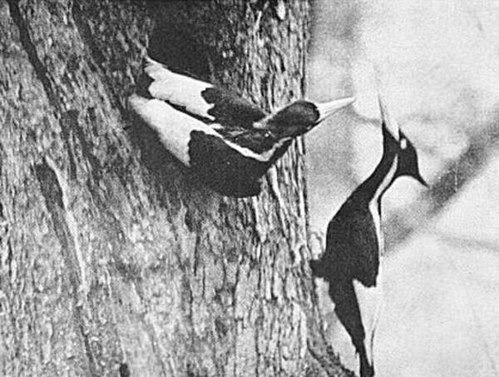
The ivory-billed woodpecker is described as a magnificent beast, aptly named the “Lord God Bird” due to the awe that it struck into its observers. It was one of the largest woodpeckers documented in North America, between 18 – 20 inches long. The bird is characterized by its black plumage, with white stripes down its neck. Males have an additional red coloring on their crest. Its distinctive ivory bill earned it its name – an important distinction to make, so that one does not confuse it with the pileated woodpecker.
According to Scott Weidensaul’s eloquent reflection published in the Smithsonian, the plight of this gorgeous bird began around the beginning of colonization, but the 1880s were when timbering became a prominent problem, rapidly decimating its numbers. A diminutive population persevered in the Singer Tract for some time. Pleas for conservation efforts were shot down by the Chicago Mill and Lumber Company’s chairman, James Griswold. He explained his position as such: “We are just moneygrubbers.”
Such callousness towards the preservation of this species leads us to where we are today – chasing endlessly what could very well be long gone.
Rediscovery?
Although there have been many claims of sightings, one notable claim of rediscovery that is often referenced in the discussion is from 2005.
In “Ivory-billed Woodpecker (Campephilus principalis) Persists in Continental North America” published in 2005 by Fitzpatrick and others, the authors claim that they have caught the elusive woodpecker on tape.
The researchers point mainly towards the patterns of white and black feathers on the bird in the footage, arguing that there are white feathers on the posterior dorsal and ventral wing surfaces, as well as a visible white streak on the dorsum. They also assert that the bird appears significantly larger than a pileated woodpecker.
The photos shown in the article itself are, with no exaggeration, incredibly blurry. One of the researchers, David Luneau, did show the footage on a YouTube video posted by Mission Ivorybill, where you can see for yourself at approximately 26:40. He spends the rest of the video giving an analysis of the footage and why he believes that this is the bird we have long sought after.
This sighting was not without dissent. David Allen Sibley – a self-taught artist and one of the best-known field guide authors – joined in on this debate. In an interview with Chris Bosak from Birds of New England, he points out that a sighting is really just an eyewitness account. Such evidence would be unreliable in something like a court setting, since a faulty memory can be misunderstood as a real memory by the brain. He says that our brains are prone to tricking us. For example, maybe the flash from the sun on the wings could suggest that a pileated woodpecker is an ivory-billed woodpecker. For something to be confirmed, Sibley asserts, an actual photograph or video needs to show up. Sibley is also the author, alongside a few others, who sought to debunk Fitzpatrick et al’s findings. This is called “Comment on ‘Ivory-billed Woodpecker (Campephilus principalis) Persists in Continental North America’.”
After the latest extinction controversy of 2021, an article popped up that refuted the Fish and Wildlife Services’s announcements. “Multiple lines of evidence indicate survival of the Ivory-billed woodpecker in Louisiana” published by Steven C. Latta and others set up cameras around the habitat during a time period of 2012 – 2021. They caught images of woodpecker silhouettes. Though not irrefutable non-blurry photographic evidence, Latta’s team includes size references to other photographs of ivory-billed woodpeckers and argues that distinctive white patterns are visible in the photos.
Ok, But is the Bird Extinct?
Well, it’s safe to say that nobody knows!
But, part of the reason the debate is so fiery is that declaring the bird “extinct” would rob it of Endangered Species Act (ESA) protections. The ESA requires resources be extended towards species considered in danger of extinction.
To declare the woodpecker “extinct” would be seen as throwing in the towel, admitting defeat, saying that there is nothing left to protect. This is a hard pill to swallow for those who still have hope – an admittedly fickle thing.
If you’ve ever seen a pileated woodpecker, you know just how incredible it is to see that huge bird slam its head into the side of a tree, announcing its presence with raucous noise as it tears through the wood to claim its bounty. To think that, at one point, there was an abundance of a woodpecker larger than even the pileated woodpecker fills one with a sense of yearning for a sight that they will possibly never see again… if we agree that the bird is extinct.
Similar to Sibley, I wish for conclusive evidence before I am willing to say this bird still exists. However, I also have sympathies that lie with Latta, as some of those silhouettes did look strikingly similar to the photos we have seen of the bird in the past.
The days of the Lord God Bird may be over, and they may have been over for a while. Or, it is also possible that the bird successfully evades numerous trail cameras, much to our dismay. Until the cycle begins again or somebody brings conclusive evidence, we may never know.
Ian ~ Mar 25, 2026 at 5:36 pm
Beautiful article. I live in Canada but have wanted to see an Ivory Bill all my life. I sincerely hope that the search continues and the bird is found.
Ian H. Kinman
Bardy Jones ~ Mar 25, 2026 at 9:07 am
True believer here. My birder sons and I spent a week paddling, and walking, through the Choctawhatchee River Swamp where Auburn University saw them about 15 years ago. What a great time!! Go Ivory bills!!
Don Anderson ~ Mar 25, 2026 at 8:53 am
“Currently unknowable” is fair. Worth considering if this is of interest to you:
– Great books on the subject.
– Contiguous habitat is vast and mostly inaccessible. No parking lots and birding trails. This bird is likely nomadic except when breeding.
– Dedicated search teams work hard for little money with many exciting stories of sightings and birds heard by seasoned “experts”.
– If it exists, it is in part due to its fear of humans. Most sighting and videos are of the bird fleeing.
– The Latta team has reportedly continued work, but is not motivated to reveal location or successes at this point in time.
I hope we can stay open minded. Much what is still “currently unknowable” keeps us humble. And there are many stories, globally, of “extinct” species simply off human radar for many decades.
Don Anderson
Mike Dailey ~ Mar 25, 2026 at 7:58 am
Fitzpatrick, like Sibley, also said a clear photo is necessary.