
When I made it to the DCU Center for my undergraduate college graduation last May, I was given a card with a QR Code on it. We all were told many times how important the card was, how we couldn’t let go of it and that we had to bring it with us to the stage. When I did, the then-Dean of Students Kamala Kiem scanned it with a reader, whispered in my ear, “Don’t start walking until you hear your name,” and soon, off I went. Suddenly, I realized why they had me input my name pronunciation when I applied to graduate.
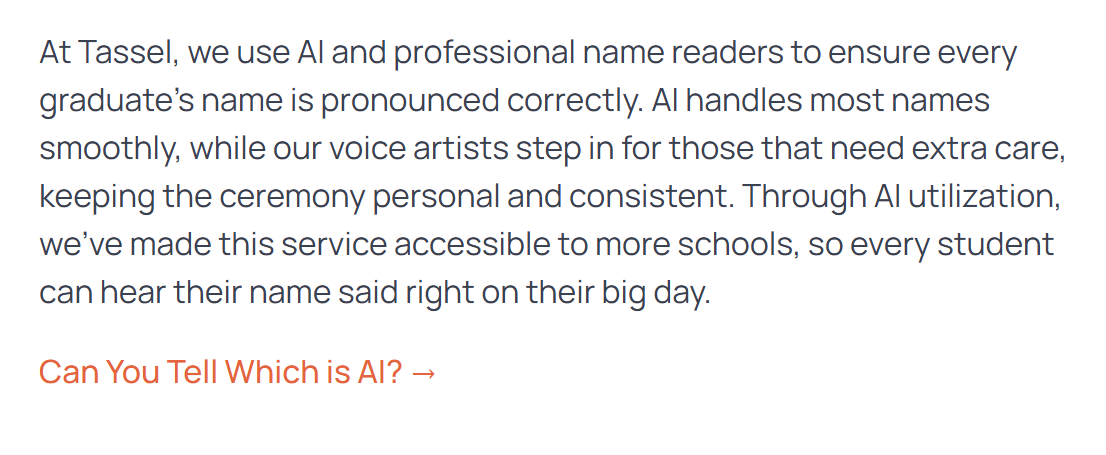
Like many schools, Clark uses a service named Tassel to handle all online graduation-related programming. Tassel had announced their usage of an AI reader in order to streamline name pronunciation and reduce the chances of a mispronunciation. But how many students, like me, did not realize that change going in?
When you register for graduation on the Tassel site, the service generates a phonetic spelling of your name, which you can then approve or edit. If you reject it three times, then they will have a professional voice artist re-record it. So, unless you go out of your way to opt out multiple times, you will have the AI read your name.
I heard a defense of this tool being that it “goes through names faster,” but I would argue that, (like with the whole pro-AI argument), some activities are not about efficiency. Yes, it is timely, but it both takes out the opportunity for an administrator to work to learn your name and to share your accomplishment in real time with another human.
And yes, I know this is a tiny, almost non-issue, but to me it speaks to the greater takeover of AI on our campus: in the past couple years, I have gone from having my undergraduate professors be vehemently anti-AI on class assignments, to my graduate professors allowing or even encouraging it, to receiving (what I suspect to be) AI-generated feedback from instructors on assignments. What is the next decade even going to look like for a college student who might not want to use it? Will they have a choice?
The greatest argument in favor of the tool’s use is that it might be able to avoid errors, and help a student feel secure that their name will be pronounced correctly on the big day. While this is anecdotal, I heard from multiple friends (and I personally remember hearing at the ceremony) that the AI tool either pronounced their name or someone else’s name wrong. Because, hey, why not rely on that famously error-free AI technology?
To me, this feels like a microcosm of Clark’s attitude as of late: putting the fancy new technology on a pedestal and completely disregarding letting the students have a say. If this is such a supportive and efficient new technology, why doesn’t it support our right to decide? As a fifth-year graduate student now, I am participating in a graduation ceremony for the third (and likely last) time, and I am (I guess) coming to terms with the fact that my only human-read graduation was at my high school in 2021.
Are our school’s well-publicized financial woes so widespread that we can’t afford to have one of the twenty-plus staff members who already are sitting behind President David Fithian at the ceremony read them?
All of us, at every graduation level, deserve to hear our names read by an actual human, one who understands the sacrifices and hard work it took to get us to this moment. And, most importantly, we deserve a choice of how our name is heard.