
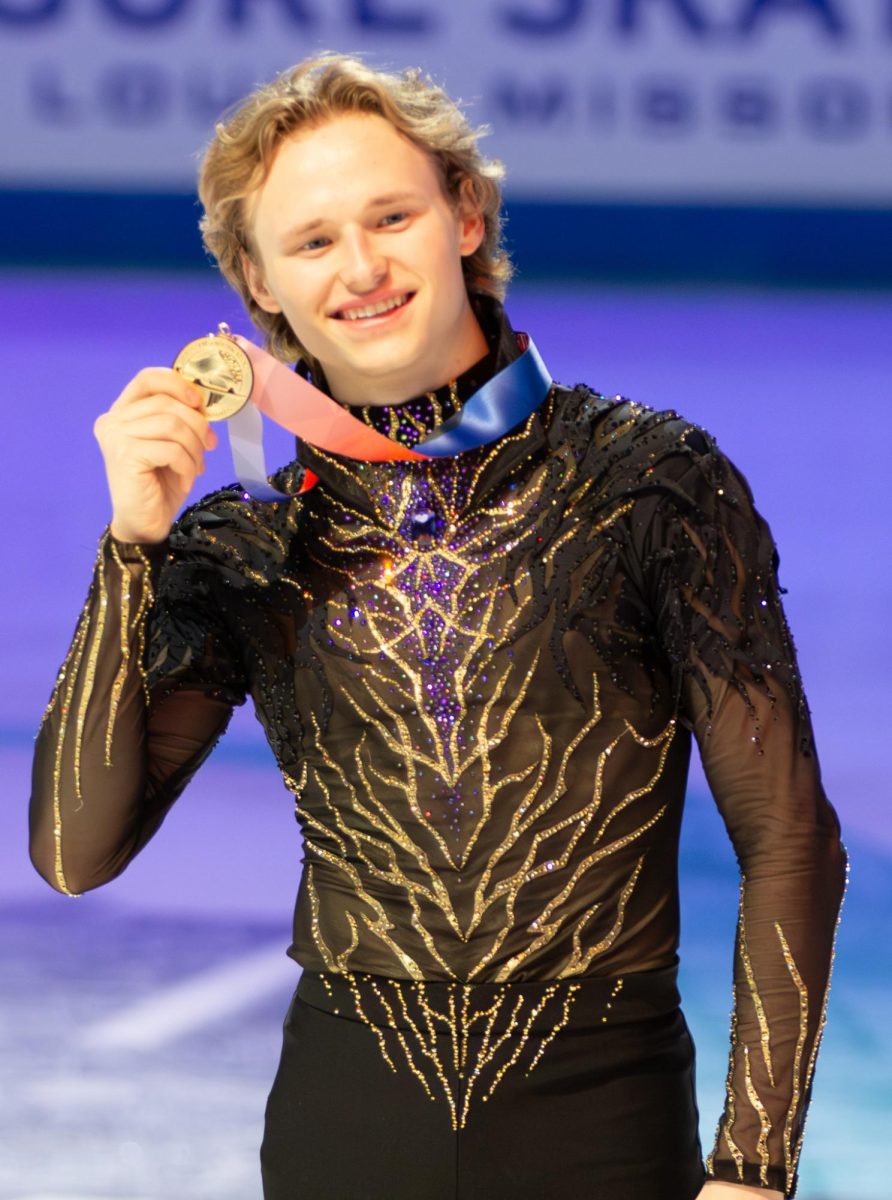
On March 28, 2026, Ilia Malinin, arguably the best figure skater of all time, secured his third consecutive Figure Skating World Championship gold medal. This was after an upset at the 2026 Milano Winter Olympics, held less than a month before the competition in Prague. Malinin, a current student at George Mason University in Virginia at their College of the Humanities and Social Sciences, has been figure skating his whole life. He started skating at the young age of six under the supervision of his parents, who are both retired Olympic figure skaters. Malinin earned his first trophy when he became the U.S. National Intermediate Champion at just 12 years old. Over the next half of his career so far, he has been able to secure 17 medals, including three World Championships and an Olympic gold medal.
Besides Malinin’s rise to the top due to his flawless technique, he has risen in fame and standing due to the unique skills that he can pull off on the ice. One of these skills is a quad axel. The qualifier for the base worth of a jump is how many rotations the skater performs during the jump. Specifically, the quad axel features an impressive four and a half rotations, making it the hardest quad jump to pull off due to the axel jump requiring half of a rotation more than all other jumps making it a uniquely hard feat.
For much of figure skating history, the quad axel was an unfathomable skill and seen as something that was physically impossible, especially in a competitive setting. In the 2022 U.S. International Classic, Malinin proved the whole skating community wrong by performing a routine which consisted of five total quadruple jumps, including the ground-breaking quad axel. At the age of 17, Malinin proved to the world that the quad axel was indeed possible and set his name in stone as the first and currently the only person to ever complete this jump in history. Since he was able to tackle this infinitely impressive skill, and knowing that there was a winter Olympics game in 2022, one may be surprised to hear that he was not a competitor for team US that year.
To qualify for the Olympics figure skating team, you must prove your advanced skill and Olympic readiness. Malinin seemingly made this qualification by coming in second in the 2022 U.S. Nationals Championship as a 17-year-old, meaning that he was a candidate to be picked by U.S. Figure Skating (USF) to be placed on the team. Despite Malinin’s placement at the national tournament, USF decided to put Jason Brown, another decorated figure skater, who had placed fourth in this competition, in Malinin’s place on the team. The USF stated that their process includes the consideration of the skater’s whole body of work as a figure skater and given that Malinin was so young and that this was his first year competing at an adult level, they saw Brown as a more favorable competitor to represent the country. Despite this setback of his opportunity to compete at a higher level, Malinin kept working to improve his skills and perfect his performance.
In 2024, Malinin started his streak of gold medal placements at the Figure Skating World Championships. During his reign, he even managed to perform the first legal backflip at an International Skating Union (ISU) event, such as the World Championship, since they raised the 1976 ban in 2024 due to the danger that doing a backflip on ice at high speeds with skates on lends itself to. Since the start of his national and international win streak, Malinin was able to secure a spot on the U.S. 2026 figure skating Olympic team in Milan. This would be his debut at an Olympic competition since missing the team in 2022. Malinin was favored to win his event due to his track record and high-difficulty routine that he was scheduled to compete with.
Malinin started the competition off well by winning gold in the team event along with Team USA after he won the final tie breaker event against Team Japan. After the team competition, the individual events were underway. All figure skating competitions consist of a two-part event; the first being the short program, lasting two and a half minutes and including seven elements and the free program lasting four minutes and including 12 elements. The overall placement is determined by combining the score from the short and free programs.
During the men’s single competition, Malinin placed first for the short program, meaning he was at a significant lead going into the free program. On the day of the free program, many were unable to stick the landing from their jumps. World-class athlete after world-class athlete slipped and fell on the ice. Leading up to Malinin’s competition, the packed audience, all there to see Malinin compete, could feel the pressure, from the global eye, put on Malinin to secure his first individual Olympic gold medal.
During his routine, jump after jump was looking grimmer and grimmer. Malinin underrotated his jumps, fell and looked distraught during the competition that was slipping through his hands. When he got off the ice, the crowd could feel the disappointment. He told reporters that he “blew it” and said that the problem “was definitely mental.” The Olympics brings an air with them that is unique to all other competitions. It is just at another level that includes nerves and feelings that are not really felt for other lower-level competitions. This put him down to eighth place, missing the podium and medal. Despite this disappointing outcome, Malinin was set on coming back strong for the World Championship less than a month later in Prague.
Malinin recovered from his disappointing performance and obliterated the competition to win the tournament. His comeback was forceful. In the 2026 World Competition, Malinin managed to land a total of seven quad jumps, two backflips and secured the victory by over 30 points. This comeback within the month is truly impressive and shows his dedication to the sport. Look out for his future competitions, as it is certain that he will break more records and cement his name even further in the history of figure skating.